




Eva Akpandja thought she had blown it.
It was her final throw in the shot put at the WIAA state track and field meet last spring. The Edgewood High School junior was the defending state champion, but she was not the top seed, and she was not in first place going into the last round. Her longest throw to that point was 43 feet. The throw at the top of the leader board was nearly 45.
“It was my last throw, and I was like, ‘yo, I need to lock in,’” Akpandja said. “I literally said a prayer with Giff (head track coach Jeff Gifford), his kids, all the other coaches that were there.”
Then she threw, and did not like what she felt.
“I stopped … and I was like, ‘Oh shoot, that was bad. That was so bad,’” she said. “And I look over at Giff, and his mouth is open.”
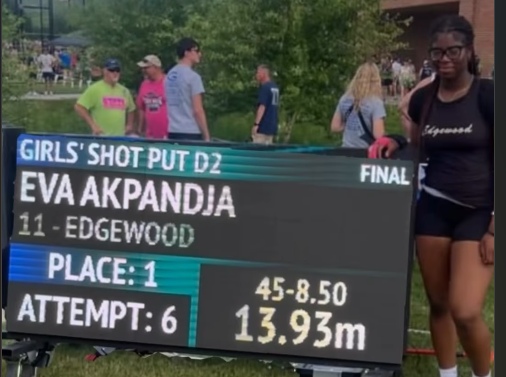
The throw measured 45 feet, 8.5 inches, and it gave Akpandja her second straight state title.
“Incredible, gutsy performance,” said Joe Frontier, who has coached Akpandja in the throws for the past two years. “Dug deep, did what she had to do on the biggest stage on her last throw against a great competitor.”
Frontier said the second title meant more than the first.
“There was zero expectation for Eva Akpandja to win a state championship her sophomore year,” he said. “Last year she went to the state meet. She wasn’t the top seed, and she was the returning state champion. That’s a whole different thing. And you go into the last round of throws, and you’re not in first, and you’re the one who is the defending champion, and then you put the biggest throw together, and you grab that state championship from a very, very talented thrower. That’s a different kind of kid.”
Now a senior, Akpandja has rebuilt her shot put technique, is weighing college track offers and has added a new sport: tonight she will line up at defensive end when No. 2 seed Edgewood hosts No. 7 seed Ripon in the first round of the WIAA Division 4 football playoffs. Kickoff is at 7 p.m. at Breese Stevens Field in Madison.
View this post on Instagram
‘Do track, do track’
Akpandja was born and raised in Madison. She attended Lighthouse Christian School for elementary and middle school, where her mother, Homnaka Akpandja, teaches. She ran the 100 meters with a middle school running club but never threw.
“I could run, I could jump, but that was mainly what I did in middle school,” she said.
That changed at an Edgewood open house before her freshman year. Jeff Gifford, who now coaches Akpandja in both track and basketball, was working the basketball and track tables.
Gifford remembers her asking whether dunking was allowed in girls basketball. “And the head coach and I kind of looked at each other like, ‘Yeah … can you dunk?’” he said.
Akpandja remembers Gifford asking what she planned to do in the spring.
“I was like, ‘Oh, I don’t know. I might do soccer, be a goalie, or I might do track,’” she said. “And he was like, ‘Do track, do track.’”
She started her freshman season as a sprinter, jumper and hurdler.
“Halfway through the season, Giff was like, ‘Have I had you do anything throwing related yet?’ And I was like, ‘No.’ He was like, ‘OK, you’re going with the throwers now,’” she said.
She still fills in on relays and in the jumps when Edgewood needs her. But Gifford said the biggest thing holding her back in the ring has been her own doubt.
“When you’re the two time state champion in the shot put, you are the best one out there. But she doesn’t necessarily always carry herself like she’s the best one out there,” Gifford said. “Sometimes it’s OK to walk around with your chest out, like you are the best one out there.”
He also said she “takes coaching, is very coachable.”
“I wish I had a team full of Evas,” Gifford said.
Learning to spin
Much of Akpandja’s off-season work happens with Throw Big, Throw Far, the club Frontier started 25 years ago as the Madison Throws Club.
“Eva came to me a couple years ago as just this kind of unrefined but very athletic kid who just kind of exuded athleticism,” said Frontier, who also coaches at Vel Phillips Memorial High School. “And this great personality, but I don’t think she knew how good she could be.”
Akpandja said the work starts in the weight room.
“You have to sort of live in the weight room, so people hate lifting with me because I’m always like, nope, let’s go. We’re doing the full thing,” she said.
The rest, she said, is mental. “If you’ve had two bad throws in the past, you have to be able to have a goldfish memory and forget about that and just go on to the next.”
Akpandja won both of her state titles using the glide, in which the thrower starts with their back to the ring and pushes across it. Before her junior year, Frontier pushed her to switch to the rotational technique, which most college throwers use and which more closely mirrors the discus throw.
She trained that way all off-season. Once the high school season started, she did not feel confident spinning and went back to the glide.
“She kind of messaged me and she’s like, ‘I think I have to glide during the season.’ And she was almost like, ‘I feel like I’ve betrayed you, Joe,’” Frontier said. He told her to go with whatever she and her high school coach believed in.
This summer, she committed to rotating. In her first session back after a month off, she threw 45 feet, about what she had thrown to win state with the glide.
“If you can throw rotationally, after taking a month off, what you did in the glide after all of last high school season, what are we talking about here?” Frontier said.
Frontier also believes her real potential lies with the discus, where she finished eighth at state last year.
“She would never ever say that, but I think that the discus is going to end up being her best event,” Frontier said.
Akpandja’s personal best in the discus is 129 feet. She calls herself a “practice warrior” in that event.
“I will throw absolute bombs in practice,” she said. “My goal is to throw 145, my first meet. You heard it here first.”
In the shot put, she wants to get as close as she can to the state record, which means she’s hoping to push near 50 feet.
From the sideline to defensive end
Akpandja spent several seasons as a manager for the Edgewood football team. On her first day of practice as a sophomore, a coach who was new to the program asked where her helmet and pads were. After that, coaches and players kept asking why she didn’t just play.
Basketball gave her another reason. At the end of her junior basketball season, coaches told her she needed to be more aggressive.
“I’ll accidentally knock someone over and I go, ‘Oh my gosh, are you OK?’ And I completely forget about the ball,” she said. “In my head, I’m like, football equals aggressive. So play football to be more aggressive.”
After her junior track season, she asked Edgewood football coach Jesse Norris if she could join the team.
“I was like, absolutely. I didn’t have any issues with it. If that’s what she wanted to do, I was going to support her in it,” Norris said.
Norris said they talked through the risk first. “Her right arm is going to get her a college scholarship. And I didn’t want to jeopardize that,” he said. “She’s like, ‘Yep, I get it. No problem. I still want to do it.’ So we did it. It’s been great.”
Gifford had the same worry. “I was kind of like, don’t get hurt because her right arm is her ticket to free college,” he said. But he wasn’t surprised by her decision. “I’ve seen her in the weight room. She lifts more than half the guys.”
Norris said the move from the sideline to the field was smooth.
“She’s a tank. She’s strong. She knows what she’s doing,” he said. “Rather than carrying water and setting up equipment, she just had pads on and was participating.” He added that there was “zero hesitation from anyone” on the team.
Akpandja said that acceptance was the first thing that surprised her. “And then also that I’m actually pretty decent at it,” she said.
Frontier sees a link between the decision and that last throw at state. “I don’t think Eva chooses to play football a year ago, and I bet you that’s going to change her mindset on the basketball court this year,” he said.
Off the field, Akpandja leads Edgewood’s BIPOC club. Norris said she is well liked by classmates far beyond her own friend group.
“She treats everybody the exact same way with a high level of respect,” he said.
‘She’s me in a big body’
Akpandja’s mother was a multi-sport athlete herself in her native Togo. Homnaka Akpandja came to Madison in 2006 through the U.S. diversity visa lottery after earning a university degree there.
“It wasn’t that easy when you get graduate from university to find a job,” Homnaka Akpandja said. “Especially being a girl is worse. They want you to settle, to get married. But my thought was to have a better life, and if I have a child one day, give her a better life.”
In Togo, she threw the javelin and shot put, ran, and played basketball, volleyball, soccer and handball. Trained as an accountant, she has taught preschool at Lighthouse Christian School for more than 14 years. This year, she also became the school’s behavior interventionist.
She tried to train her daughter early, but young Eva only wanted to swim. Now Homnaka Akpandja watches her daughter compete in the events she once did.
“I’m proud. I feel like she’s me in a big body,” she said. “I’ll support her in whatever she chooses to do. I’m not her, and God have a plan for her.”
Akpandja has scholarship offers from Wisconsin and Minnesota. She plans to study sports medicine. Wisconsin high schools do not throw the javelin, but she said she is open to adding the that and hammer in college.
Even in an individual event, she said, teammates matter. On her UW visit, she paid attention to “how easily I’m able to talk to the other people because those are gonna be my possible future teammates.”
“I’ve also done team sports all my life, so I try to still find the team aspect in such an individual sport,” she said.
Frontier said every thrower she would face at the Big Ten level was likely to be a high school state champion. When he sat down with Akpandja and her mother this summer, she told him she wanted that challenge.
“I think the biggest difference between Eva two years ago and the Eva now is I don’t think she would even fathom wanting that challenge two years ago,” he said.
He thinks moments like last spring’s final throw will keep changing how she sees herself.
“She goes out and keeps doing it, and pretty soon you’re gonna be like, maybe these coaches aren’t crazy, maybe I’m the one crazy for doubting myself,” Frontier said. “And all of a sudden, you become the confident person who maybe starts just, ‘Hey, I’m gonna go out and do this, because apparently I am able to.’”